The United Nations Assistance Mission in Afghanistan (UNAMA) is a UN Special Political Mission tasked with assisting the people of Afghanistan.
UNAMA was established on 28 March 2002 by United Nations Security Council Resolution 1401.
Reviewed annually, this mandate has been altered over time to reflect the needs of the country and was extended for one year, on 15 June 2026, by Resolution 2822 (2026)
Resolution 2678 stresses the important role that the United Nations will continue to play in promoting peace and stability in Afghanistan.
The Security Council also passed a second Resolution 2679 (2023) calling for an integrated and independent assessment with forward-looking recommendations for an "integrated and coherent approach" to address Afghanistan’s challenges.
The Security Council also recognized that the renewed mandate of UNAMA is consistent with its resolutions 1662 (2006), 1746 (2007), 1806 (2008), 1868 (2009), 1917 (2010), 1974 (2011), 2041 (2012), 2096 (2013), 2145 (2014), 2210 (2015), 2274 (2016), 2344 (2017), 2405 (2018), 2460 (2019), 2489 (2019), 2543 (2020), 2596 (2021), 2626 (2022)
The United Nations has been involved in the region since 1946 when Afghanistan joined the General Assembly. Agencies such as UNICEF have been operating in Afghanistan since 1949.
UNAMA's headquarters is in Kabul, and it maintains a field presence across Afghanistan, as well as liaison offices in Pakistan and Iran. The Mission has around 782 staff: 508 Afghan nationals, 186 international staff, 58 international UNVs, and 30 national UNVs (Figures from October 2026). The Mission has offices in Bamyan, Faizabad, Gardez, Herat, Mazar-e-Sharif, Kabul, Kandahar, Kunduz, Maimana, Pul-i-Khumri, and Jalalabad. UNAMA opened a temporary remote office in Almaty, Kazakhstan, in September 2021 to continue international humanitarian cooperation as a result of the Taliban takeover.[2]
UNAMA is headed by Rabab Fatima as the Special Representative of the Secretary-General (SRSG) for Afghanistan.
Nine Special Representatives preceded her – Lakhdar Brahimi who served from October 2001 to January 2004, despite resigning from the post 2 years earlier; Jean Arnault who held the post from February 2004 to February 2006, followed by Tom Koenigs from March 2006 to December 2007, Kai Eide from 2008 to 2010, Staffan di Mistura from 2010 to 2011, Ján Kubiš from 2012 to 2014, Nicholas Haysom from 2014 to 2016, Tadamichi Yamamoto from 2016 to 2020, Deborah Lyons from March 2020 to March 2022 and Roza Otunbayeva from 2022-2025.
Since 2008, and following a directive from the UN Secretary-General, UNAMA has been an integrated mission. This means the Special Political Mission, all UN agencies, and funds and programmes work in a multidimensional, integrated manner to better assist Afghanistan according to nationally defined priorities.
Two deputy Special Representatives (DSRSG) oversee the main pillars of the mission – political and developmental issues. Included under these pillars are mission sections specializing in issues such as political analysis, reporting, and outreach, and donor coordination, as well as the coordination of UN agencies funds and programmes.
Political affairs pillar of UNAMA
The political affairs pillar is led by a Deputy Special Representative responsible for supporting political outreach, conflict resolution, and regional cooperation. Georgette Gagnon serves in this capacity. The pillar includes analysis and reporting, political affairs, rule of law, the gender unit and liaison’s offices in Islamabad and Teheran.
Development and Humanitarian Assistance
The development pillar is headed by the Deputy Special Representative and focuses on development, humanitarian assistance, and coordination of UN agencies, funds, and programmes. Bruno Lermaquis serves in this capacity as well as Resident and Humanitarian Coordinator. UNAMA's development pillar further integrates development efforts in Afghanistan, especially on capacity building and coordinating humanitarian assistance from international bodies. The DSRSG also coordinates the work of the UN Country Team (UNCT).
The UNCT in Afghanistan comprises 20 agencies, funds and programmes with offices in Afghanistan:
- FAO (Food and Agriculture Organization)
- IFAD (International Fund for Agricultural Development)
- ILO (International Labour Organization)
- IOM (International Organization for Migration)
- OCHA (UN Office Coordination of Humanitarian Affairs)
- OHCHR* (Office of the High Commissioner for Human Rights)
- UN WOMEN (United Nations Development Fund for Women)
- UNAIDS (United Nations program on HIV/AIDS)
- UNDP (United Nations Development Programme)
- UNESCO (United Nations Educational, Scientific and Cultural Organization)
- UNFPA (United Nations Population Fund)
- UN-HABITAT (United Nations Centre for Human Settlements)
- UNHCR (United Nations High Commission for Refugees)
- UNICEF (United Nations Children’s Fund)
- UNIDO (United Nations Industrial Development Organization)
- UNITAR (United Nations Institute for Training and Research)
- UNMAS (United Nations Mine Action Service)
- UNODC (United Nations Office on Drugs and Crime)
- UNOPS (UN Office for Project Services)
- WFP (World Food Programme)
- WHO (World Health Organization)
*OHCHR is integrated with UNAMA, working under direction of the SRSG
FOLLOW UNAMA ON TWITTER
Universal Declaration of Human Rights turns 75
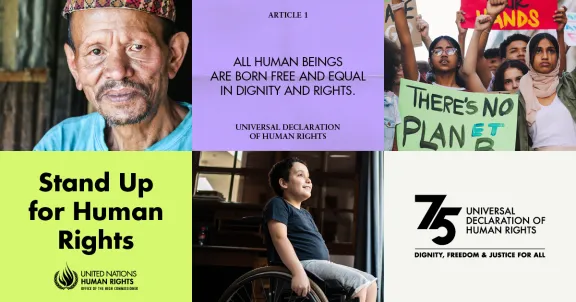
UDHR 75 Pashto
UDHR 75 Dari