Respect for the human rights of all Afghans lays at the heart of UNAMA’s work in Afghanistan. UNAMA’s Human Rights Service, which also represents the Office of the UN High Commissioner for Human Rights, leads the Mission’s work in monitoring, reporting and advocating on the human rights situation in Afghanistan as mandated by the UN Security Council. See under UN Security Council resolutions on Afghanistan.
The Mission’s human rights strategy is implemented through on-the-ground monitoring, documentation, reporting, advocacy and engagement with all key interlocutors, including relevant duty bearers in Afghanistan. On the basis of this work, UNAMA calls for all human rights violations to be investigated, for those responsible to be held accountable, for victims to access justice; without these measures, impunity prevails, and human rights violations continue. It calls for equality and non-discrimination, with all (women, men, girls and boys) who live in Afghanistan being considered integral to society. Their rights must be fully respected, promoted and protected in all spheres of daily and public life.
UNAMA’s Human Rights work focuses on:
- Protection of Civilians - undertakes independent and impartial monitoring, documentation and reporting of harm caused to the population due to an incident, including during at times of armed clashes and armed conflict, and advocates for the protection of civilians at all times.
- Right to Life, Liberty & Physical Integrity - documents and reports on violations of international human rights law, including arbitrary arrests and detentions, torture and ill-treatment, cruel, inhuman and degrading punishments, as well as enforced disappearances and extrajudicial killings.
- Women’s Rights, including the Elimination of Violence against Women and Girls – focuses on monitoring and reporting on aspects of women’s rights across the priority areas of UNAMA’s human rights work and on the elimination of violence against women and girls in coordination with relevant UN agencies; its documenting and reporting inform efforts to advance gender equality and rights of Afghan women and girls.
- Detainees’ Rights – engages with detention authorities pursued at the national and sub-national levels, advocates for the improvement of detention conditions, the prevention of torture and ill-treatment, monitors places of detention as well as promotes of the rights of detainees (including the respect of procedural safeguards), and documents human rights violations in detention contexts.
- Fundamental Freedoms – monitors and reports on fundamental freedoms in Afghanistan, which includes the right to freedom of expression, opinion, peaceful assembly and association. This also includes media freedom and the public’s access to information. It follows the situation for human rights defenders, journalists and media workers, as well as ethnic and religious communities. It advocates for an independent national human rights institution, in line with Paris Principles, with a broad mandate to protect and promote all human rights in Afghanistan.
- Children and Armed Conflict – monitors grave child rights violations as per the relevant Security Council Resolutions. UNAMA contributes to the UN-led Country Task Force on Monitoring and Reporting with the aim to promote accountability and protection of children given the disproportionate impact of war on children.
The priority areas reflect UNAMA’s mandate and serve as key benchmarks in the current security, political, social and economic context in Afghanistan. UNAMA also supports Afghanistan’s implementation of international instruments on human rights and fundamental freedoms to which Afghanistan is a State party and by which it is bound.
Research, monitoring, documentation, and reporting on human rights violations and abuses informs UNAMA’s initiatives and advocacy aimed at advancing all Afghans’ (women, men, girls and boys) meaningful access to, and full enjoyment of, their rights.
UNAMA HRS has been publishing a series of thematic reports highlighting various human rights issues in Afghanistan. UNAMA HRS engages with the relevant de facto entities on thematic reports prior to their publication. As per standard practice, thematic reports are sent to the de facto authorities for factual comments. Comments received are attached as an Annex to the published report. Since 2023 UNAMA HRS has also been issuing periodic human rights updates on the human rights situation in the country.
For a list of human rights-related publications, see Monitoring and Reporting, Protection of Civilians and Other Reports.
For a comprehensive search for all UNAMA reports and publications see Document Library
FOLLOW UNAMA ON TWITTER

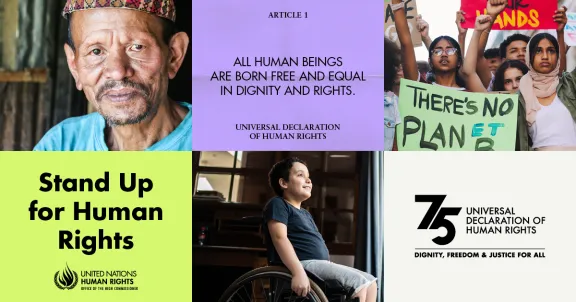
Universal Declaration of Human Rights turns 75
UDHR 75 Pashto

UDHR 75 Dari